




Ad mediation is one of those concepts most publishers use, but few fully understand.
It sits quietly in the background, deciding which ad shows, which network wins and how much revenue each impression generates. When it works well, monetization feels steady and predictable. When it does not, publishers often assume CPMs are just “lower than expected.”
In reality, mediation is often the difference.
This post breaks down what ad mediation is, how it works and why it matters for mobile publishers looking to maximize revenue without adding operational complexity.
What ad mediation is
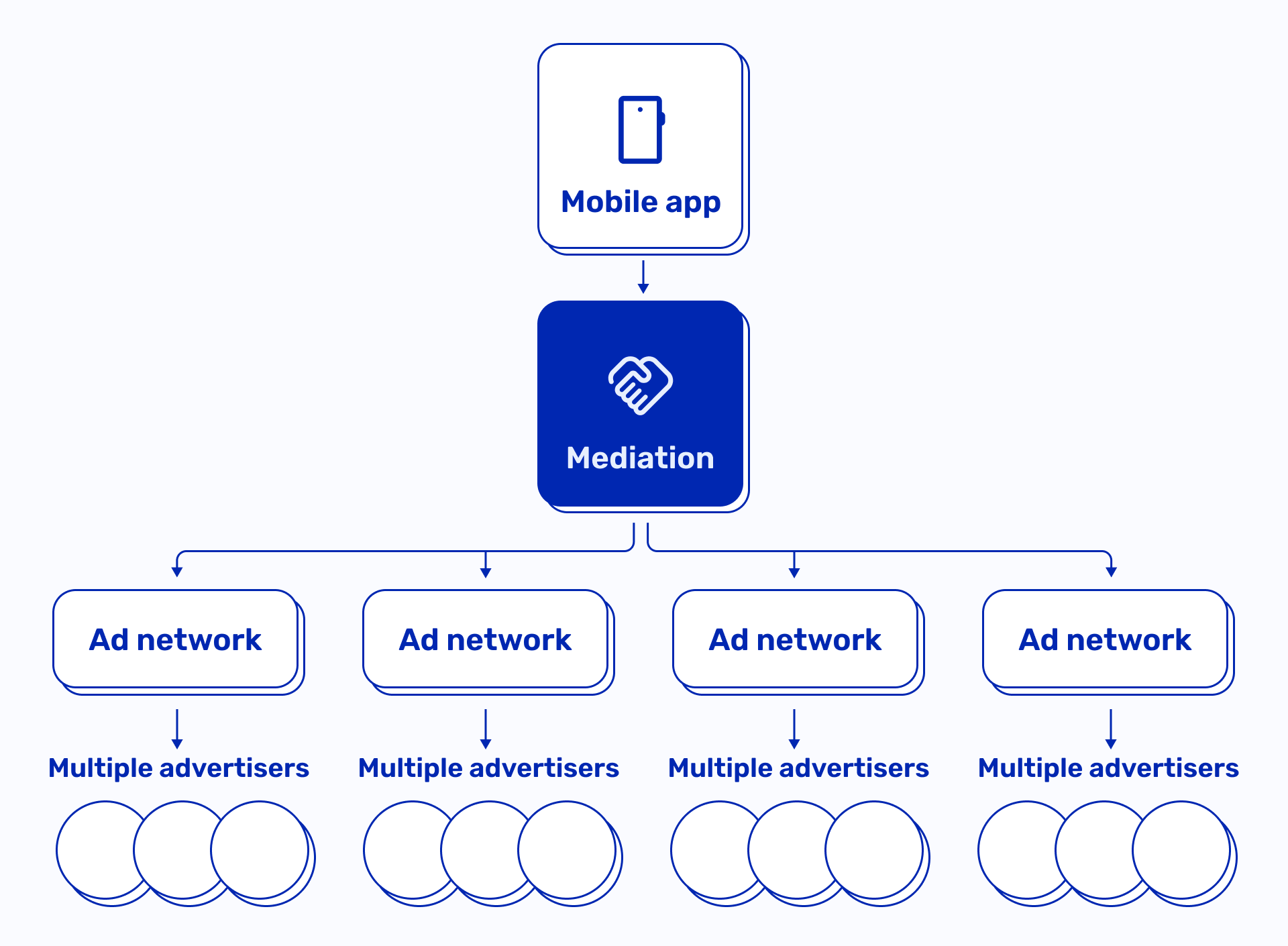
At its core, ad mediation is a system that connects multiple ad networks and demand sources to a publisher’s app and decides which ad gets served for each impression.
Publishers rarely rely on a single ad network. Different networks perform better in different regions, formats and user segments. Ad mediation allows all of that demand to be managed in one place instead of through multiple SDKs and dashboards.
Without mediation, publishers would need to:
- Integrate and maintain several ad network SDKs
- Manually prioritize networks
- Continuously adjust logic based on performance changes
That approach does not scale.
Ad mediation centralizes these decisions and automates the selection process so the highest-value ad can be served for each impression.
Ad mediation as an auction
The simplest way to understand mediation is to think of it as an auction.
Every time an ad impression becomes available, multiple demand sources want the opportunity to show an ad. Each demand source values that impression differently based on the user, location, device and context.
Ad mediation determines how that competition happens.
In modern setups, mediation platforms enable:
- Real-time bidding, where demand sources submit bids simultaneously
- Waterfall logic, where networks are prioritized based on historical performance
- Hybrid models that combine both
The goal is to maximize competition for each impression, as more competition generally leads to higher CPMs and better overall yield.
Waterfalls vs bidding: how publishers run mediation
Historically, ad mediation relied on waterfalls.
In a waterfall, networks are ordered by priority, with the first network getting the opportunity to fill the impression. If it does not, the request moves to the next network, and so on.
Waterfalls are simple but rely on historical averages that do not reflect real-time value.
In-app bidding improves on this by allowing all participating networks to bid at the same time. The highest bid wins, and pricing reflects the true value of that impression in that moment.
Most publishers today run hybrid setups:
- Bidding for networks that support it
- Waterfalls for networks that do not
This approach ensures broad demand coverage while still enabling real-time competition where possible.
Why ad mediation matters for publishers
Ad mediation impacts more than just CPMs.
For publishers, a well-designed mediation setup provides:
- Higher fill rates by accessing multiple demand sources
- Incremental revenue through increased competition
- Reduced SDK bloat by limiting integrations
- Faster testing and optimization without frequent app updates
- Centralized reporting and clearer performance visibility
As apps scale globally, these benefits compound. Regional demand differences become more pronounced, and manual optimization becomes less effective.
Mediation allows monetization to scale alongside user growth.
Where BidMachine fits into ad mediation
One reality publishers eventually run into is that not all mediation platforms are neutral.
Many mediation setups prioritize their own demand by default. Even when bidding is enabled, certain demand sources may get preferential treatment through tighter integrations, better signal access or default configurations that are difficult to override. Over time, this can limit true competition and reduce visibility into what is actually driving revenue.
This is where BidMachine plays a different role.
BidMachine is built SDK-first and designed to give publishers more control and transparency inside their mediation stack. Instead of routing demand through opaque layers, BidMachine brings demand directly into the app and lets it compete at the impression level.
Because BidMachine operates independently from traditional mediation ownership structures, publishers get:
- Clear visibility into who is bidding and at what price
- Greater control over how demand is prioritized and evaluated
- Real-time auctions powered by on-device signals rather than historical averages
- Incremental demand that competes fairly alongside existing partners
This approach helps reduce situations where demand is favored simply because it is vertically integrated into the mediation layer.
Importantly, BidMachine can be tested incrementally, allowing publishers to start with a subset of apps, ad formats or geographies, measure performance side by side and scale only where it proves value.
If you want more transparency and control in your auctions, the next step is simple: run a BidMachine mediation test and see the results for yourself.

