




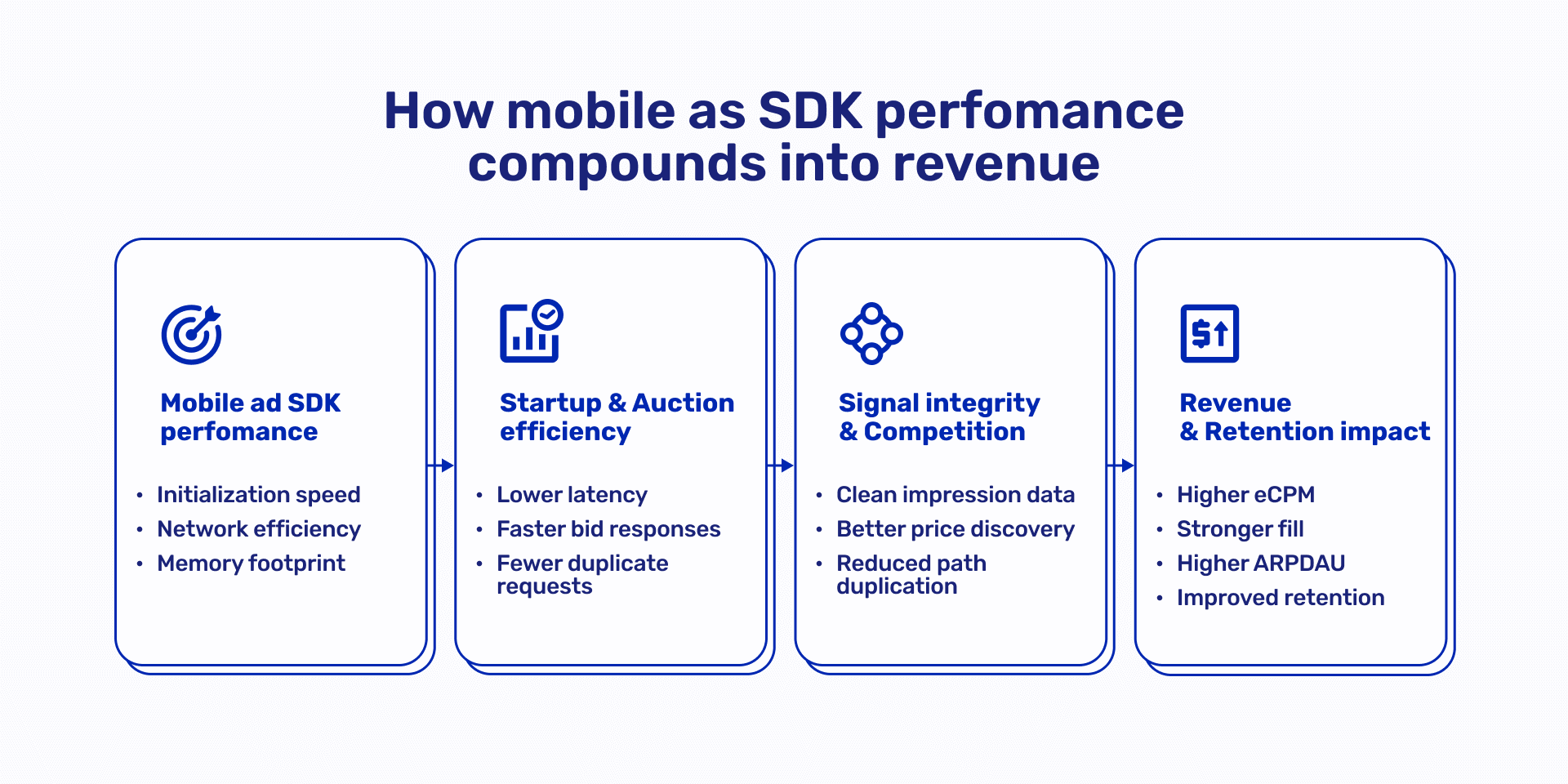
While mobile ad SDK performance is often treated as a technical concern, for publishers it directly affects revenue, auction efficiency, retention and long-term monetization.
Many teams focus on CPMs, fill rates and demand mix. But the SDK itself plays a foundational role in how well those metrics perform. A poorly optimized SDK can increase startup time, create latency during auctions and degrade user experience. Over time, that performance drag translates into lower ARPDAU.
If monetization is infrastructure, the SDK is the foundation.
This post breaks down how mobile ad SDK performance impacts revenue, what to watch for and how publishers should evaluate SDK partners.
1. Startup time and its revenue impact
Startup time is one of the most sensitive moments in the user journey. If your app takes too long to load, users abandon before they even see content or ads.
Ad SDKs often contribute to startup bloat because they may:
- Install lifecycle listeners at launch
- Make network requests immediately
- Read or write to disk
- Initialize multiple internal services
Each of these actions can add milliseconds, and when multiple SDKs initialize simultaneously, delays compound. For publishers, the revenue impact typically appears as higher churn before first ad exposure, reduced session frequency and lower long-term retention.
Even small startup improvements can translate into meaningful ARPDAU gains because monetization depends on users actually entering and staying in the app.
2. Auction latency and yield efficiency
Performance does not stop at launch, as SDK performance also affects how quickly auctions execute.
Long waterfalls can trigger multiple sequential calls for the same impression. Each call increases latency and reduces auction efficiency. In contrast, optimized in-app bidding setups send a single request and allow demand to compete in real time.
High SDK performance supports:
- Faster bid responses
- Reduced duplicate requests
- Cleaner auction logic
- Better alignment between impression value and clearing price
Lower latency improves fill rates and increases effective competition, which directly impacts eCPMs and ARPDAU.
In performance-driven environments, milliseconds matter.
3. Signal fidelity and data quality
Another overlooked aspect of mobile ad SDK performance is signal integrity.
Modern bidding depends on contextual signals, device data and user behavior signals. If supply paths are inefficient or layered with intermediaries, signal quality can degrade. That reduces a buyer’s ability to value impressions accurately.
Strong SDK performance supports:
- Clean impression-level data
- Transparent auction logs
- Reduced self-competition across paths
- Better optimization for DSP machine learning systems
When buyers trust the data and see performance, budgets scale. This is particularly important for premium and brand demand flowing through Supply Path Optimization strategies.
Although often treated as technical hygiene, signal quality directly affects demand quality and spend allocation.
4. SDK weight and app stability
Because the average mobile app integrates numerous SDKs, each additional integration increases complexity and potential risk.
Heavy or unstable SDKs can contribute to memory pressure, increased crash rates, failed ad requests and conflicts with other SDKs.
For publishers, this instability means lost impressions and frustrated users.
Evaluating SDK performance should include:
- Initialization behavior
- Network request efficiency
- Memory footprint
- Impact on crash rates
- Compatibility with mediation platforms
Revenue growth should not come at the expense of stability.
What publishers should prioritize
When evaluating a mobile ad SDK, publishers should look beyond headline CPMs.Ask:
- Does the SDK initialize efficiently?
- Does it support real-time bidding integrations?
- Is auction data transparent and accessible?
- Is it certified across major mediation platforms?
- Does it contribute incremental demand without bloating the app?
Mobile ad SDK performance affects every impression. The right SDK should increase competition while maintaining speed and stability.
Earn more from every impression with BidMachine
The BidMachine SDK is built for performance, transparency and incremental revenue growth.
Publishers using BidMachine benefit from:
- A lightweight SDK designed for fast integration
- Real-time bidding and mediation compatibility
- Certification with AppLovin MAX and Unity LevelPlay
- Transparent auction data and unified analytics
In practice, publishers typically see average ARPDAU lifts of 3–5% across diverse app categories.
Integration is usually completed in approximately two weeks, allowing teams to test performance improvements without long implementation cycles.
If you are evaluating mobile ad SDK performance and looking to increase revenue without compromising user experience, explore the BidMachine SDK and see how it can drive incremental growth across your apps.

