




For years, mobile publishers have debated one question: Is in-app bidding actually better than waterfalls?
Ask ten publishers and you’ll likely get ten different answers.
The truth is not that one model is universally “right.” Neither model is universally right, as each solves a different problem, and understanding how they work allows publishers to maximize revenue without sacrificing control or performance.
This post breaks down the differences between waterfalls and in-app bidding, when each makes sense, and how publishers are increasingly combining both as the ecosystem evolves.
How waterfall mediation works
The waterfall model is the original approach to ad mediation.
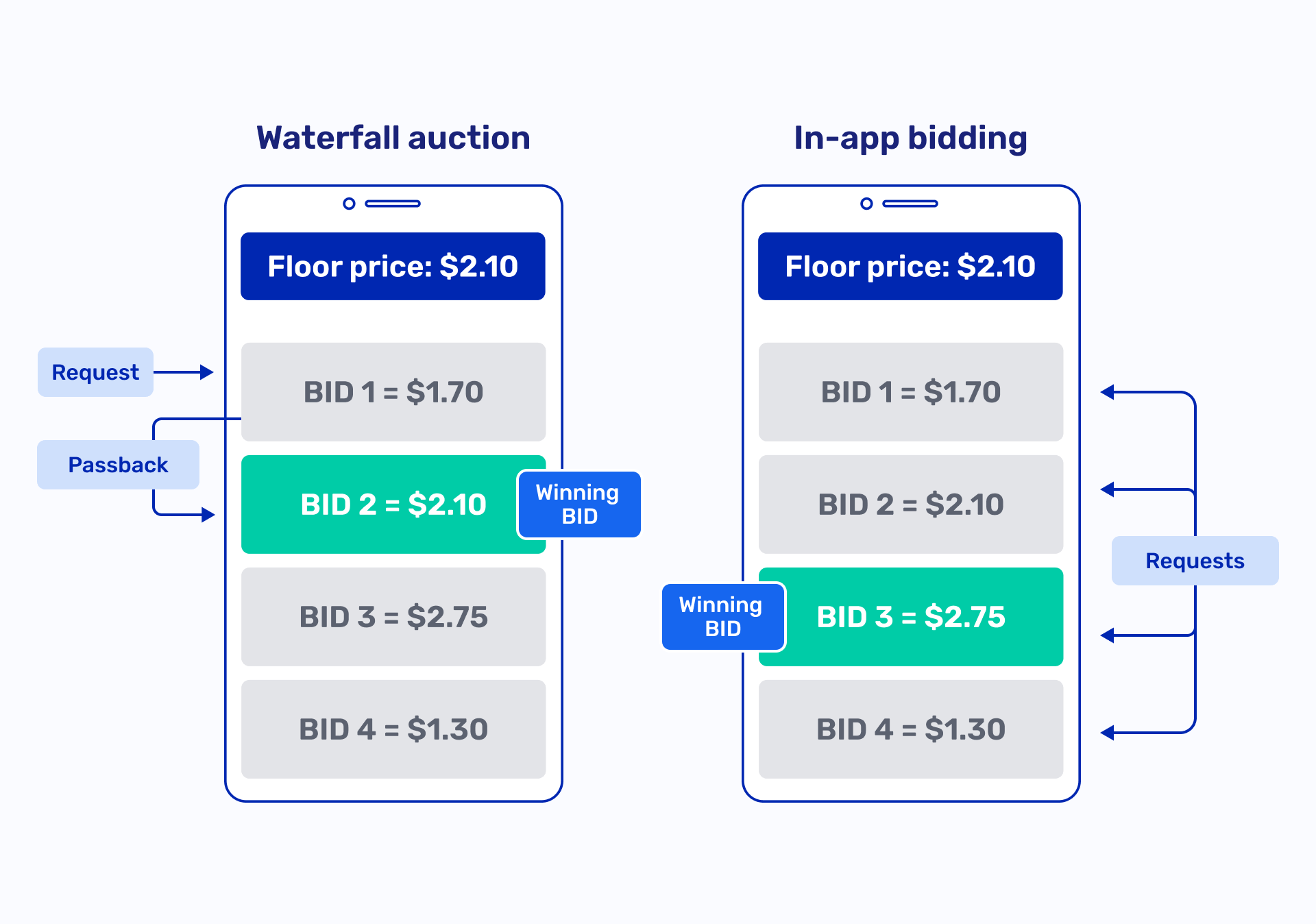
In a waterfall setup, publishers rank ad networks in a fixed order based on historical performance. When an ad impression becomes available:
- The top network gets the first opportunity to fill it
- If it does not fill, the request moves to the next network
- This continues until an ad is served or the waterfall is exhausted
Waterfalls give publishers explicit pricing control, with CPMs set manually, often by country, format and user segment, but that control comes with tradeoffs.
Waterfalls require constant maintenance, including:
- Monitoring fill rates and latency at each price point
- Adjusting CPM floors regularly
- Maintaining large numbers of line items
- Accounting for seasonal shifts and changes in user-level signals
Because waterfalls rely on historical averages, they struggle to reflect the real-time value of each impression.
How in-app bidding works
In-app bidding takes a different approach.
Instead of calling networks one by one, all participating demand sources bid on the impression at the same time. Each buyer decides how much the impression is worth based on real-time signals such as user behavior, device, location and context, where the highest bid wins.
For publishers, this means:
- Pricing is set by the market, not by static CPM floors
- All demand competes fairly at the same moment
- Auctions reflect real-time value instead of historical assumptions
In-app bidding also simplifies operations. There are fewer line items to manage, less manual optimization and lower latency compared to long waterfalls.
Performance and efficiency differences
One of the biggest practical differences between the two models is latency.
Waterfalls often trigger multiple sequential ad calls for a single impression. This adds delay and creates inefficiencies, especially as waterfalls grow longer.
In-app bidding removes this sequential process. A single request is sent, bids are returned and a winner is selected immediately.
In most publisher tests, moving traffic from SDK waterfalls to SDK bidding has led to higher ARPDAU, improved eCPMs and better auction efficiency without increasing impression volume.
Importantly, these gains often come from reduced latency and stronger competition, not from showing more ads.
Why some publishers still use waterfalls
Despite the growth of in-app bidding, waterfalls have not disappeared.
Some publishers prefer waterfalls because they:
- Allow manual pricing control for specific partners
- Make it easier to prioritize brand or top-funnel demand
- Fit better with certain regional or direct deals
In some cases, waterfalls are effective at capturing demand that does not yet support bidding.
The downside is that poorly configured waterfalls can limit competition. When pricing or prioritization is misaligned, performance-focused buyers may reduce bids or stop participating entirely, which can hurt long-term revenue.
This is why most large publishers now run hybrid setups.
The hybrid reality: bidding plus waterfalls
Today’s reality is a combination of bidding and waterfalls.
Most publishers:
- Run in-app bidding for networks that support it
- Use waterfalls for remaining demand sources
- Continuously shift more traffic into bidding as adoption increases
As more ad networks move toward bidding-only models, the share of revenue coming from bidding continues to grow.
The key lies in designing auctions that maximize competition while preserving control where it matters, instead of choosing sides.
Where BidMachine fits into in-app bidding
As more publishers adopt hybrid setups, the focus shifts from choosing between bidding or waterfalls to how demand is allowed to compete and how much transparency publishers have into the auction.
BidMachine is built SDK-first and focused on real-time in-app bidding. It brings demand directly into the app and allows it to compete at the impression level using richer on-device signals.
Notably, BidMachine is one of the first platforms certified for in-app bidding with both AppLovin MAX and ironSource, making it easy to integrate into existing mediation setups.
Publishers using BidMachine gain:
- Real-time competition from incremental demand
- Greater transparency into bidding behavior and pricing
- Lower reliance on long, fragile waterfalls
- A lightweight SDK designed for performance
Beyond bidding, BidMachine also supports mediation and DIRECT placements, giving publishers multiple ways to monetize:
- Mediation to manage multiple demand sources
- Direct placements to access premium brand budgets through clean supply paths
If you’re looking to modernize your monetization stack, check out BidMachine’s SDK, mediation and DIRECT placements and let demand compete in real time across your apps.
Source: Emarketer

